CHICAGO--(BUSINESS WIRE)--
New research from Iridio by RRD uncovers Americans aren't just paying more for groceries, they're increasingly paying a tax with their time, convenience and lifestyle.
New research from Iridio by RRD uncovers Americans aren't just paying more for groceries, they're increasingly paying a tax with their time, convenience and lifestyle. Iridio’s 2026 State of Grocery & CPG Report reveals 79% of U.S. adults spend additional time each week trying to save money on groceries compared with three years ago.
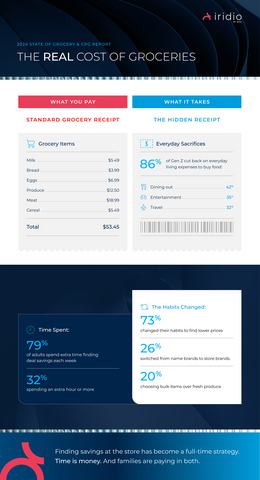
Iridio’s 2026 State of Grocery & CPG Report reveals 79% of U.S. adults spend additional time each week trying to save money on groceries compared with three years ago, while 78% have reduced or eliminated spending in other areas because of grocery costs. For younger consumers, the impact is even more pronounced: 86% of Gen Z respondents cut lifestyle spending to afford food, led by reductions in dining out (42%), entertainment (35%) and travel (32%).
Conducted in partnership with Wakefield Research and based on surveys of 1,000 nationally representative U.S. adults and 300 U.S.-based grocery, CPG and mass retail decision-makers, the research reveals an emerging “value optimization economy,” in which consumers are trading time, convenience and brand preference to stretch household budgets, while businesses invest in technology and operational infrastructure to respond faster.
“We’ve reached a tipping point where saving money on food has become a second job for many households,” said Beth Johnson, Grocery Industry Strategist at RRD and Iridio. “Consumers are willing to trade their personal data, time and brand loyalty, but only if retailers give them tangible, real-time value in return. The brands that win tomorrow will be those that solve this efficiency crisis for shoppers on the shelf.”
Trading Time, Convenience for Savings
Economic pressure is changing not only what consumers buy, but how much time and effort they're willing to spend finding value.
- Time tax on savings: 79% of adults spend additional time each week trying to save money on groceries compared to three years ago, with 58% spending at least 30 extra minutes and 32% spending an hour or longer seeking deals.
- Price-driven shopping: 73% of consumers adopted new shopping habits over the past year, and among those who changed the way they plan meals or manage their grocery budgets due to cost anxiety, 45% seek the lowest price on every item in their cart.
- Fewer trips and tradedowns: 29% of shoppers make fewer, smaller trips, 26% cut name-brand items, and 20% swap fresh produce for bulk or shelf-stable goods.
- Coupons remain essential: 36% rely more on print or digital coupons, with 38% keeping physical home-delivered coupons as visual reminders and 46% willing to scan in-store QR codes for exclusive rewards.
The Rise of the Value Optimization Economy
Consumer shifts are creating new demands for retailers and CPG brands. As shoppers become more deliberate about where and how they spend, retailers must deliver value with greater speed, precision and relevance.
Iridio’s report found consumers are increasingly willing to exchange data for tangible savings. When asked what they would want a grocery store or product brand to do if it knew their shopping habits extremely well, 52% want alerts when their preferred products are on sale and 50% want personalized discounts. Nearly half (48%) would also allow a grocery retailer to use AI to predict their shopping list if doing so guaranteed lower prices.
The takeaway for retailers and CPG brands is clear. Consumers aren't necessarily rejecting personalization or AI, they're demanding a meaningful return for it. Technology becomes more valuable when it translates into lower prices, better offers or a simpler shopping experience.
Retailers Invest in Technology, but Execution Remains a Challenge
Meeting these expectations requires retailers and CPG companies to modernize the systems behind the shopping experience. Yet hybrid fulfillment demands, margin pressure and fragmented data continue to create operational challenges.
- Single-source advantage: 100% of retail decision-makers see a competitive advantage in using a single-source partner to manage packaging design, in-store print marketing and direct supply chain distribution.
- Cost of consumer demands is the top business threat: The cost of adapting to shifting consumer demands ranked first among enterprise concerns at 55%, followed by consumer affordability pressures at 52% and AI-powered shopping agents at 39%.
- Omnichannel fulfillment is reshaping operations: Click-and-collect and delivery growth have forced 99% of decision-makers to alter packaging and labeling requirements, with 44% reporting a major operational impact.
- Brands are defending equity: As consumers trade down to private-label products, 53% of decision-makers report CPG brands are investing heavily in premium visual branding and specialty packaging.
- Supply chain technology leads investment priorities: Decision-makers identify supply chain inventory tracking and automated fulfillment (37%) as their top projected capital investment for next year, ahead of digital marketing (29%) and computer vision (24%).
The Retail Execution Gap
The challenge isn't simply understanding what consumers want. It's executing on those expectations quickly enough. Iridio's research found that 35% of retail decision-makers say their inventory data is too slow, resulting in organizations routinely selling products online that are already out of stock on the physical shelf. Inventory inaccuracy across digital and physical shelves is also the single biggest operational hurdle to executing an omnichannel strategy, cited by 28% of decision-makers.
Meanwhile, the continued growth of click-and-collect and delivery is putting additional pressure on packaging and labeling operations, affecting requirements for nearly all companies.
Collaboration between retailers and CPG brands presents another obstacle. Thirty percent identify the inability to agree on uniform data points across inventory, digital app interactions and brick-and-mortar checkout transactions as the biggest roadblock to real-time collaboration.
The result is a growing gap between the speed at which consumers expect value and the speed at which retail organizations can deliver it. For today's shoppers, that gap comes with a cost—not just in dollars, but in time, convenience and lifestyle.
To see the complete 2026 State of Grocery & CPG Report, visit https://go.iridio.com/state-of-grocery-report.
About Iridio
Iridio simplifies marketing complexity by unifying creative, media, and data and analytics in one platform. As a trusted marketing partner to top brands in retail, healthcare, financial services, and other industries, Iridio's data-driven solutions connect brands with their audiences at defining moments. Backed by RRD’s legacy and global scale, Iridio offers a flexible suite of services that range from single-channel campaign activations to fully integrated programs, enabling brands to optimize the customer journey and achieve meaningful business results.
About RRD
RRD provides a complete portfolio of marketing, packaging, print and business services to the world’s most respected brands, including 92% of the Fortune 100. The company’s proprietary technology, advanced data analytics and established expertise fuel organizational decision-making, from strategy through execution. With operations in 30 countries, global organizations and regulated industries trust RRD to reduce complexity and drive audience connections across the entire customer journey.
Source: IridioNew research from Iridio by RRD uncovers Americans aren't just paying more for groceries, they're increasingly paying a tax with their time, convenience and lifestyle. Iridio’s 2026 State of Grocery & CPG Report reveals 79% of U.S. adults spend additional time each week trying to save money on groceries compared with three years ago.